Advanced SAFe Practice Consultant (ASPC)
Advanced SAFe Practice Consultant
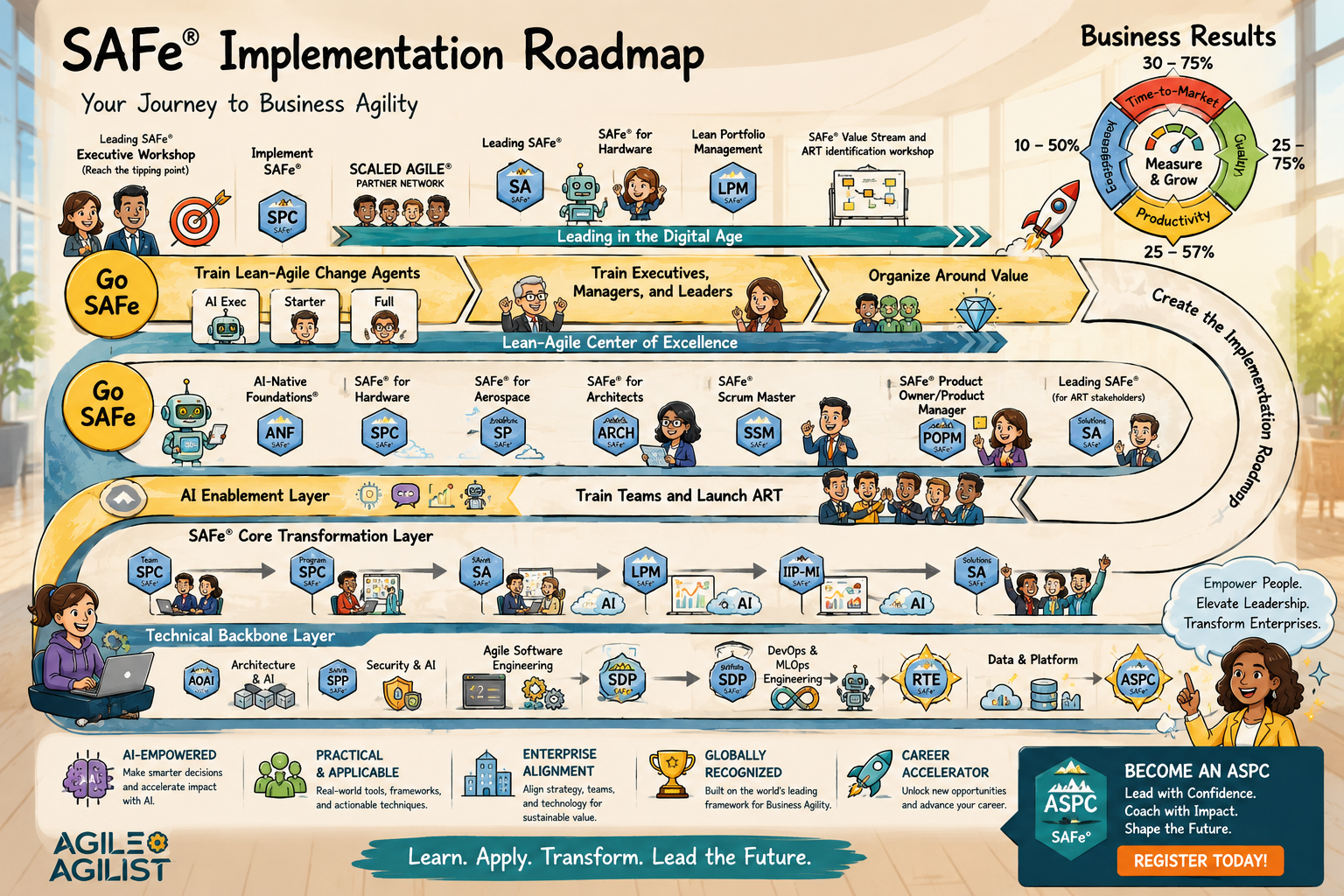
ASPC — the peak of SAFe coaching expertise
Designed for practicing SPCs ready to lead multi-train value streams, architect portfolios, and embed Dimensions 3, 4, and 5 — AI-Native, AI Automation, and Mutation — into enterprise operations.
~125 SPCTs globally · SPCT-led cohorts · D3/D4/D5 embedded
Who Needs ASPC — and Why Now
As organizations scale SAFe beyond pilot Agile Release Trains, the gap between framework adoption and measurable outcomes widens. The Agile System Program Coach (ASPC) credential closes that gap by equipping experienced practitioners to lead multi-ART coordination, Portfolio Kanban governance, and continuous flow at the program level — not just facilitate ceremonies.
ASPC is designed for practitioners who have already operated inside a SAFe enterprise and are now accountable for making the system work across trains, value streams, or portfolios. The credential is explicitly not an introductory certification — it validates field-tested competency at systems scale.
Ideal Candidate Profiles
- Release Train Engineers (RTEs) leading two or more ARTs and coordinating cross-train dependencies at the Large Solution or Portfolio level
- Solution Train Engineers (STEs) responsible for capability coordination across multiple ARTs and Suppliers
- Lean-Agile Center of Excellence (LACE) leads tasked with driving transformation maturity beyond initial launch cohorts
- Enterprise Agile Coaches engaged under SOW agreements where measurable throughput and predictability outcomes are contractually expected
- Portfolio Managers and Chief Product Officers who need fluency in SAFe Lean Portfolio Management to govern funding, strategy, and OKR alignment
- Transformation Program Directors managing multi-year, multi-vendor SAFe rollouts across business units or geographies
Organizations in regulated industries — financial services, defense, healthcare IT, and energy — account for a disproportionate share of ASPC candidates because cross-functional dependency management and audit-ready documentation of decision governance are non-negotiable in those environments.
Competency Dimensions Assessed
The ASPC assessment evaluates seven discrete competency dimensions drawn from SAFe’s Business Agility framework and calibrated against observed enterprise transformation outcomes. Each dimension is scored independently, and an overall credential requires demonstrated proficiency across all seven — not simply an aggregate pass score. This structure prevents candidates from compensating shallow capability in one area with depth in another.
Each submitted evidence artifact is reviewed by a panel of credentialed ASPC assessors. Reviewers score against published rubrics and provide written developmental feedback regardless of pass or deferral outcome — a feature that distinguishes this credential from purely exam-based certifications. Detailed competency rubrics, evidence requirements, and the seven-dimension assessment model are provided in full during eligibility onboarding.
Preparation Cadence and Readiness Milestones
ASPC preparation is not a sprint — it is a structured, time-boxed program that mirrors SAFe’s own planning cadence. Candidates work through a defined sequence of preparation phases over roughly 12 to 16 weeks, each with a gate criterion that must be met before advancing: eligibility audit, dimension self-assessment, guided study and artifact development, mock assessment and calibration, formal submission, assessor panel review, and credential award or structured deferral.
Candidates actively engaged in PI Planning cycles typically find that real-time work generates the richest evidence artifacts. Aligning the preparation cadence with your organization’s PI boundaries — rather than treating it as a parallel effort — is the single strongest predictor of first-submission success.
Enterprise Cohort Engagements
Organizations deploying SAFe at scale frequently need to credential multiple practitioners in parallel while ensuring organizational alignment — not just individual competency. The enterprise cohort model synchronizes preparation cadences, surfaces systemic gaps in how SAFe has been implemented internally, and produces shared artifacts that double as organizational capability documentation. Sponsor organizations receive a post-cohort capability report that maps credentialed competencies against open transformation risks — a governance artifact suitable for transformation program reviews or board-level reporting.
Frequently Asked Questions
What are the formal prerequisites?
Candidates must hold a current SAFe Program Consultant (SPC 5 or later) certification and demonstrate a minimum of two years in a role with direct accountability for multi-team or multi-ART SAFe delivery. Attendance at a SAFe for Lean Enterprises or equivalent SAFe training event within the past three years is required. Candidates without SPC standing but with equivalent demonstrated expertise may petition for a prerequisite waiver through the formal review process.
How is the assessment scored, and what constitutes a passing result?
Each of the seven dimensions is scored on a four-point rubric: Emerging, Developing, Proficient, and Distinguished. A credential award requires a minimum of Proficient on all seven dimensions, with no single dimension scored below Developing. Candidates who achieve Proficient or Distinguished on five or more dimensions but fall below threshold on one or two receive a targeted deferral with a 90-day resubmission window for the specific deficient dimensions only — the full portfolio does not need to be resubmitted.
Can evidence artifacts be drawn from confidential client engagements?
Yes. Assessors routinely evaluate artifacts from confidential engagements. Candidates are expected to anonymize client and organizational identifying information before submission. The submitted artifact review process is governed by a formal non-disclosure agreement that all assessors sign prior to panel participation. Structural and methodological substance — not brand names — drives scoring, so anonymization does not disadvantage candidates.
How long is the credential valid, and what does renewal require?
The ASPC credential carries a three-year validity period, aligned with SAFe’s major version release cycle. Renewal requires documentation of 40 continuing practice hours in relevant SAFe or scaled-agile practice areas, plus attestation of active practitioner engagement — not simply passive learning consumption. Holders who allow the credential to lapse must re-apply through the full process; there is no abbreviated reinstatement path once the grace period expires.
Does ASPC preparation align with SAFe 6.0 specifically?
All preparation materials, assessment rubrics, and evidence artifact templates are maintained against the current production version of the SAFe framework. When SAFe publishes a major version update, preparation materials are reviewed and updated within 60 days of publication. Candidates who began preparation under a prior version and are mid-cycle when a new version publishes receive a delta briefing document and have access to version-specific Q&A sessions at no additional charge.
Ready to go deeper?
Whether you are preparing an individual candidate or standing up an enterprise cohort, our practice advisors will walk through your specific context, readiness posture, and the fastest credible path to ASPC.